Saturday, August 25, 2012

On the Road to Bountiful

Mormon Wagon Train 1852
In 1761, brothers James and Lieutenant John Johnson arrived in Nova Scotia from New Hampshire and established a prolific family in the area called Lower Village, Truro.  James was my 4th great grandfather and John, who married Sarah Hogg my 4th great great uncle.  Years later, Eleanor Johnson, John's granddaughter set out on an adventure that has been chronicled in the history of the Mormon Church.


Samuel Henry Lufkin
In March 1814, Eleanor met and married Samuel Henry Lufkin of Westford, Massachusetts.  The two lived in Nova Scotia where their first two children were born.  In subsequent moves they lived in Acworth, New Hampshire, Kirtland, Ohio and then in Vermont.

In letters sent home from Vermont, Eleanor writes to her daughter, Sarah and her brother, James Johnson.


Londonderry Nova Scotia
April 27th 1835

My Dear Daughter

I avail myself of this opportunity to inform you that I am still alive and in tolerable health for a person of my advanced age. I live in the same place with my son James and his family who are all in good health, they have a family of six children alive, and two died. four boys and two girls alive. 

The girls names are Eleanor Jane and Sarah Ramsey. The boys names are John Young and Timothy, William Henry and Orlando. They are very good children. I am surprised you did not write and let us know your state, and how your husband and children were. It would aford me much comfort to hear from you all. We heard of Mr. Lufkin was dead but had no certain information.

Your brother Timothy's family are much in the same state you left them, only Lavinia is married to a Mr. Johnson and has two boys. Your sister Rachel and family are well. Your brother Adam and family were well when we heard from them last. I wont be tedious to mention the many deaths and marriages that occured here since you left this place.

About three years ago I wrote you by Mr. Weir, who went to Boston, but received no answer, in it I informed you of the death of your sister Salley Ramsey who died about five years ago before the date of that letter, and the death of your father which took place about three years before the date of the same. 

I am the only survivor of my fathers family and am old and feeble and it would afford me much comfort before I go home to hear from you all. Sally Ramsey's only child (Eleanor) is here these five years. She is a fine steady girl.

Please write immediately and be particular in letting me know how you all are. Our united affection to you all.

I remaine my dear son and daughter,

Your affectionate Mother, Eleanor Johnson

To Mr. James Johnson,
Londonderry,
County of Halifax, Nova Scotia
May 24, 1848

Long absent yet not forgotten,Mother, brothers sisters and friends. 

I now embrace the present opportunity of informing you of my health and family which is good at present and I hope these lines will find you enjoying the same blessing. 

I received your letter dated March 29, 1845 and was very glad to hear from you. I hope you will excurse me for neglecting to answer your letter the cause of me not writing as I agreed to was my youngest child Charles Henry was taken sick and lie sick a great while with the tufus fever, and I kept neglecting it thinking I should go west with the brethern and I calculated to write to you when we started but I fell in hopes the Lord will open a way for us to be gathered with the rest of our brethern we still belong to the Church of Jesus Christ of Latter-day Saints and believe it to be the only true church on Earth with which the Lord is well pleased. 

You wrote in your letter you believed Joseph Smith was an imposter I beleive him to be a true prophet of God as any of the old prophets were in ancient times, brother James and sister Rachel condem me not for my religious principles for the judge standeth at the door for he that feareth God and worketh rightiousness is accepted with him. As it is impossible at present for me to visit you I want you should be particular in writing to me about your family. Rachel's Timothy's and Adams how they are settled in life and especially Rosannah and Eleanor Caroline Ramsey. 

I should like to have you write concerning Uncle John Johnson and family and about the old neighbors I will now write concerning ourselves. We have taken a farm in Bristol to the halves there is a good sugar orchard on the farm it hasn't been a good year for sugar we haven't made over 300 pounds for our share, we shall not be able to sell much if any.

 There is a fruit orchard also we make a good living here better than we could in Nova Scotia. Sarah and Asenath that are married are doing well, they haven't any children. Sarah lived about ten miles from us and Asenath is at home on a visit she lives about 30 miles from us across lake Champlain, Cyrus we haven't heard anything from since I wrote to you before we heard his wife and child they were will his wife's name is Sarah Ann Goodel and his childs name is Leanora jenette we have three children at home with us now there names is George Washington is 17 in June he is a very steady boy he puts me in mind of Timothy in looks and actions Jane Ann is taller than I am she will be 14 in November Charles Henry will be 9 in July he is a real rattle head he is very tall of his age and slim. 

they are good schollars of their age, all of them belong to the temperance society, I want to know if temperance prevail in that country.

 Our crops of potatoes have failed us for two or 3 years. I should like to know how it is with your potatoes down there. I want you to write to me if any of my relations have moved to the U.S. because there was a letter come to the Postmaster of Lincoln inquiring of the postmaster if he knew where Samuel Lufkin lived. If so write to him immediately he has lost the letter and forgot the name and place. 

I want you should write to me if any of them has moved to the U.S. if so please write their names and the place. I should life to have you all come out here to live I think it is a far better country that where you now live. Give my love to Mother and sister Rachel's family and Timothy's family and Rosannah and Eleanor Caroline and take the same to yourself and family. Write immediately when you recieve this not as I have done. Give my love to all inquiring friends.

This from your affectionate sister, 
Eleanor Lufkin to James Johnson [1]


George Washington Lufkin
Samuel became a disciple of the Mormon prophet, Brigham Young and in 1852,  when Eleanor was 57, the entire Lufkin family joined a wagon train destined for Utah.  They were part of the Captain Isaac Bullock company.  The journey was arduous and, in Illinois, they joined up with a wagon train bearing the dreaded Cholera infection.

10 days later, Eleanor died of the dreaded disease and was buried alongside the trail. Samuel completed the journey with his son, George Washington Lufkin, who became a veteran of the Walker Indian War and a High Priest in the Mormon Church.  George's wife, Martha Townsend was the daughter of a close associate of Brigham Young and very committed to his teachings.

The original home of Samuel Henry Lufkin, in Bountiful, Utah has recently been designated a national historic site and is to be preserved by the state.

Quite the adventure for a young girl from Truro.

Wednesday, August 22, 2012

Captain George Duncan Simmonds - Civil War Veteran

Captain George Duncan
Simmonds
Relationship: George was my third cousin, three times removed.   We both descend from John Campbell and Mary Scott.

Captain George D. Simmonds was born on the 29th of November 1843 in Londonderry, Colchester County, Nova Scotia.  When he was a young man, he left Nova Scotia and emigrated to the United States.  As the Civil War progressed he joined the Union Army and took part in many of the major battles, including Shiloh, Chattanooga, Missionary Ridge, Kenesaw Mountain, Chattahooche River and Nashville.

At Shiloh he was shot through the shoulder and suffered some debility from that wound for the remainder of his life.  

In late 1862, he was detailed to accompany the bodies of several fallen comrades to their homes in Madison, Wisconsin.  Among them was the body of Private James Bridges.  On the day of their wedding, following the ceremony and wedding dinner, Private Bridges received his orders to report immediately to his regiment.  He left later in the day and never again saw his bride, Eliza Jane Sigsby.

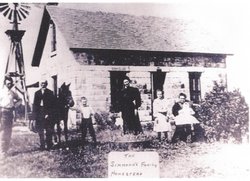
Simmonds Homestead
Cedar, Kansas
Eliza was ever grateful for the kindness shown by Captain Simmonds and the two began a correspondence.  On December 7th, 1864 George and Eliza married in Bristol, Wisconsin.  On the completion of the war, the couple moved to Cedar, Kansas and settled down to farming.  They raised five children and had a very happy life until Eliza's death in 1883.

A year or so after Eliza's death, George married Sylvia Baker, who herself was a young widow.  They met at a convention of Civil War Veterans, being introduced by Sylvia's father.

George and Sylvia moved to Abilene, Kansas where they had a cattle ranch and lived there until George's death in 1911.

Monday, August 20, 2012

Our Seafaring Ancestors

I guess it stands to reason that, surrounded by the sea, many of our early ancestors made their living on the bounding main.  To date, I have discovered 74 early family members who Captained their own ships.  Here are some of their stories.

Captain James Beattie Hill (5th cousin, twice removed)

USS Finland - 1919
On August 5, 1919, the great ocean transport ship, "Finland", sailed into New York harbour - its flag at half mast in respect for their Commander, James Beattie Hill.  As he would have wished Captain Hill, died suddenly on the bridge of his beloved ship. Born in Great Village, Nova Scotia in 1863, James married Annie Esther Spencer of Londonderry.  The couple had four children including twin daughters.

The Finland had a company of nearly 3700 and was used during World War One as a troup transport, where in 17 trips it carried some 60,000 troups without the loss of a single man.

The officers of the Finland accompanied his remains to the Hill home in Great Village and participated in James' funeral.

Captain John Geddes 3rd (1st cousin 4 times removed)

Avon River near Windsor, Hants, Nova Scotia
Captain John  was born in 1820 at Highland Village and married Isabella Urquhart.  They had 10 children.  John was the nephew of our great great grandmother, Esther Cooke

John owned his own little ship which was built at Highland Village, Nova Scotia.

In the early to mid 1880s, much of the travel between villages in coastal Nova Scotia was done on the water and John made regular trips from Five Islands to Windsor carrying fish, produce and other agricultural products to the larger town.  In November 1871, he set sail with a cargo of dressed pork and beef which he planned to trade for some Christmas treats for his family.

The Bay of Fundy is famous for its amazing high tides and, near the mouth of the Avon River, close to Windsor, Captain John's little vessel was wrecked a mile or so offshore.  A heavy winter storm prevented the transport of the remains back to Five Islands and so the victims of the accident were buried in the churchyard at Chivaree, near the Noel Shore where the bodies were recovered.

Although Isabella, Captain John's wife remarried, she insisted on being called Isabella Geddes until the day she died.

Captain David Chisholm (1st cousin, 5 times removed.) & (3rd cousin, 4 times removed)

Portaupique Beach
Cemetery
David, the son of William Chisholm and Mary Cooke was born in 1808 in Londonderry, Nova Scotia and although he spent over 40 years at sea, found time to sire 9 children with his wife, Mary Yuill.  His obituary tells you much about the man, himself:


"A GREEN OLD AGE

Mr. David Chisholm, of Mount Pleasant, Great Village, is one of Colchester's veterans, who is remarkably smart in his old age. he lives with his daughter, Mrs. Robert Elliott, and has lately been visiting for two or three months with another daughter, Mrs. Daniel McLaughlin, Pleasant Hills, Economy. He is 87 years of age, having been born Dec. 15th, 1808. 

His conversation about past events is most interesting; and his memory of the many exciting events of the long ago, is truly remarkable. With almost minute detail can he describe the "happenings" of 70 and even 80 years ago. 

Mr. Chisholm followed a sea-faring life for over 40 years, and with the exception of a little rheumatism, he is now a wonderfully preserved man. He reads without glasses, and though once a great slave to tobacco, has overcome the habit, and is now master of the situation in this respect. His wife was a daughter of the late John Yuill, of Lower Truro.

The 'News' wishes this aged veteran many years yet of continued good health and happiness. [Truro Daily News - Jan 6 1896]"

David is buried in the Portaupique Beach Cemetery on the shore of the Bay of Fundy.


Sunday, July 29, 2012

Our Trailblazing Ancestors - Part 4


Harrigan homestead
Kinkora, Ontario


David Daniel Harrigan (1792-1875) and Christianna O’Hearn (1787-1850)

David Daniel Harrigan & Christianna O’Hearn 
  Daniel David Harrigan & Mary Dolan 
    David Paul Harrigan & Catherine Mary Harrigan 
      Daniel Peter Harrigan & Florence Mary Dowd 
        Dorothy Madeleine Harrigan & Russell Mackie Bragg
           Me

Graves of David and Christiana
St. John the Evangelist
Caledon, Ontario
David and Christianna were both from County Cork Ireland and that is where they married.  Their four eldest children, Daniel, David, Eleanor and Catherine were all Irish born.  In 1832 David and his brothers Dennis and Jeremiah travelled with their families to Canada.  Jeremiah died on the voyage, leaving his young widow, Jane Mahoney and their infant daughter, Susan on their own.  Dennis settled in New Brunswick and was the 4th great grandfather of Bing Crosby.  

David carried on down the Saint Lawrence by cattle boat and created a farm at Caledon in Peel County.  They had four more children, William, Edward, John and Francis.  After Christianna’s death in 1850, David married Jane Mahoney Harrigan, widow of his brother Jeremiah.  Both David and Christianna are buried at St. John the Evangilist Catholic Cemetery in Caledon.

Martin Dowd (1815-1905) and Brigit Duffy (1811-1897)

Martin Dowd & Brigit Duffy 
  John Joseph Dowd & Mary Florence McCarthy 
    Florence Mary Dowd & Daniel Peter Harrigan 
      Dorothy Madeleine Harrigan & Russell Mackie Bragg
        Me

Martin Dowd and his bride, Brigit were born in Kilglass, County Sligo, Ireland and emigrated from Ireland to Peel, Ontario as part of the great famine migration of 1847.  Eventually they settled in Wentworth, where Martin opened a butcher shop.  The pair raised seven children, Helen, Catherine, Mary Ann, John Joseph, Thomas, Margaret and James.  Bridgit died on May 25, 1897 in Wentworth and Martin followed her in April of 1905.  Both are buried at St. John the Evangelist Catholic Cemetery in Caledon. 

Hugh Kennedy(1817-1864) and Mary Kennedy (1825-1897)

Hugh Kennedy & Mary Kennedy 
  Catherine Mary Kennedy & David Paul Harrigan 
    Daniel Peter Harrigan & Florence Mary Dowd 
      Dorothy Madeleine Harrigan & Russell Mackie Bragg 
        Me

Grave of Hugh and Mary
Kennedy
St. Patrick's Cemetery
Kinkora, Ontario
Hugh Kennedy was another ancestor who came to Canada to escape the great famine.  Along the way, he met, courted and married a distant cousin, Mary Kennedy in Toronto.  The pair settled in Kinkora, Ontario and were neighbours of the Harrigans there.  They raised a family of three girls, Catherine Mary, Julia and Elizabeth; and three boys, Daniel, Cornelius and Dennis.  Hugh died in 1864 and is buried at St. Patrick’s Church, Kinkora and Mary followed him in 1897.  Their eldest daughter married David Paul Harrigan.


Thomas Dolan (1783-1871) and Mary Quinn (1807-1857)

Thomas Dolan & Mary Quinn 
  Mary Dolan & Daniel David Harrigan
    David Paul Harrigan & Catherine Mary Kennedy 
      Daniel Peter Harrigan & Florence Mary Dowd 
        Dorothy Madeleine Harrigan & Russell Mackie Bragg 
          Me

Mary Dolan Harrigan
Thomas Dolan and Mary Quinn are quite a mystery.  We know of them only by examining the records of Mary Dolan, their daughter.  Mary was born in Ireland and so we are not even sure that Thomas and Mary ever set foot in Canada.  Mary Dolan married Daniel David Harrigan in 1840 in Caledon, Ontario.  In about 1850, the family moved to Kinkora and began farming there.

Friday, July 27, 2012

Our Trailblazing Ancestors - Part 3


William Nicholson (1720-1795) and Lady Janet Smith (1724-?)

William Nicholson & Janet Smith 
  Rebecca Nicholson & William James Moore 
    Margaret Moore & James Charles Campbell 
      John Scott Campbell & Janet Chisholm 
        John Campbell & Sarah Simmonds 
          Flora Ann Campbell Beattie & John William Gamble 
            Julia West Gamble & John Thomas Bragg 
              Russell M Bragg & Dorothy Harrigan 
                Me

William, a stay maker and his bride, Janet were said to have eloped to Nova Scotia aboard the passenger ship Willmington in 1749.  There is no documented evidence relating to Janet’s title of “Lady”.  She may have been the daughter of a peer or the name could simply be a given name.  The two settled in Portaupique, on the Bay of Fundy and raised a family of six Rebecca, Janet, Agnes, John, James Smith, William.  They lost an unnamed daughter in infancy.  William and Janet are buried at Portaupique.


John MacDonald Geddes and Rebecca McLellan (1741-1838)

John M Geddes & Rebecca McLellan  
  Isabella Geddes & James Cook 
    Esther Cook & John Gamble 
      John William Gamble & Flora Ann Campbell Beattie 
        Julia West Gamble & John Thomas Bragg 
          Russell M Bragg & Dorothy Harrigan 
            Me

Grave of Esther Cook Gamble
Castlereagh Pioneer
Cemetery
Castlereagh, Nova Scotia
The origins of John Geddes are a complete mystery. He is recorded on his marriage bond, dated May 7 1773, as "John MacDonald alias Geddes, Halifax, Yeoman, bachelor". This would seem to imply that he had adopted the use of the Geddes surname at some point before his marriage. It is without a doubt that he used the name John Geddes all his adult life.

John's wife Rebecca, had been previously married to Thomas Bibby, whose name appears on the 1767 grantee list for the settlement of Economy on the northern shore of the Cobequid Bay. He died soon afterwards and Rebecca became heir to the family property. It is quite likely that John & Rebecca may have lived upon this property before selling it in 1779. They eventually made their home a few miles down the shore, at Highland Village, a neighbouring community to Great Village, where her parents had settled in 1761.

John "Geddis" served as a Corporal in the 84th Regiment of Foot within the 2nd Battalion of the Royal Highland Emigrants. The 84th was the first Highland regiment to be raised outside of Scotland and the 2nd Battalion was raised in Nova Scotia, New York and the Carolinas during the Revolutionary War and placed under the command of the Major John Small. Because of his rank, historians of this regiment are lead to believe that he must have been a veteran and served elsewhere. It is interesting to note that there were some restrictions to joining the 84th and that you had to be at least "5 feet 3 inches in height, appear healthy, have all his limbs, no rupture, not be troubled by fits and have at least two teeth that met". The 2nd Battalion was based to Nova Scotia and took part in the relief of Fort Cumberland and so this being the case, John was at least active in protecting the Cobequid area of the province that lay so near his home and family. At the close of the war John was discharged at Fort Edward, Windsor, Nova Scotia on October 10th 1783.

Julia West Gamble Bragg
John and Rebecca raised four children, Isabella, John, Joseph and Alexander.  While we have no record of John’s death, we know that Rebecca was a widow when she died in 1838.  They are buried at Highland Village, Colchester County, Nova Scotia.

Thursday, July 26, 2012

Our Trailblazing Ancestors - Part 2


Joseph McLellan (1715-1777) and Isabelle Steele (1719-1805)


Joseph B. McLellan & Isabelle Steele
  Robert McLellan  & Janet Nicholson
    Isabella McLellan & John Chisholm
      John Scott Campbell & Janet Chisholm
        John Campbell & Sarah Simmonds
          Flora Ann Campbell Beattie & John William Gamble
            Julia West Gamble & John Thomas Bragg
              Russell M Bragg  & Dorothy M Harrigan
                Me

Great Village, Nova Scotia
As with many of our ancestors, the McLellans were part of the Ulster Scot migration from the area around Londonderry, Northern Ireland to Nova Scotia in 1761 under the sponsorship of Alexander McNutt.  They settled in Londonderry Township, Colchester County, Nova Scotia near the lovely little place called Great Village.  The first to arrive were  the three adult sons who immediately sent back to Ireland for their parents, Joseph and Isabelle to join them.  It is said that Isabelle was so anxious to see her sons that she left the plodding ox cart miles from their destination and ran ahead to meet them.  The 1770 census shows that Joseph and his sons took full advantage of their generous land grants and were quite prosperous only 8 years after their arrival.  In his will, Joseph specifically bequeathed to his grandson the remainder of his wearing apparel that was not used for his burial.  

James Johnson (1719-1798) and Elizabeth Patterson (1727-1776)

James Johnson & Elizabeth Patterson
  Rachel Johnson & James Rogers
    Jane Rogers & John Bragg
      Charles Bragg & Matilda Swallow
        John Thomas Bragg & Julia West Gamble
          Russell M. Bragg & Dorothy M Harrigan
             Me
Grave of Elizabeth Patterson
Robie Street Cemetery
Truro, Nova Scotia
James and Elizabeth emigrated from Ulster in the early 1750s and settled in Londonderry, New Hampshire, British North America.  Five years later the French were expelled from Nova Scotia by a vengeful British Government. Great grants of free land was offered to both New Englanders and the Ulster Scots to create a permanent English speaking presence on the former French landholdings.  James, Elizabeth and their nine children were among the fifty families to take up this offer.  This group was known as the Cobequid Planters and they were the original grantees of the area around present day Truro.  The couple had two more children and created a prosperous farm in the lower village.  Elizabeth died in 1776 and James remarried Margaret McRoberts and had three more children.  Last year Nova Scotia celebrated the 250th anniversary of the arrival of the Cobequid Planters.


William Cook (1720-1766) and Sidney Holmes (1730-1812)


William Cook & Sidney Holmes
   John Cook Sr.  & Margaret Berry
    James Cook & Isabella Geddes
      Esther Cook & John Gamble
       John William Gamble & Flora Ann Campbell Beattie
          Julia West Gamble & John Thomas Bragg
            Russell M. Bragg & Dorothy M Harrigan
              Me

      
Grave of Sidney Holmes
William and Sidney were married in Donegal, Ireland and emigrated to Nova Scotia in 1761 with his brother James and the rest of the Ulster Scots.  Settling on a 500 acre grant at Portaupique, on the shores of the mighty Bay of Fundy, the pair added three children to their family of four. They set about working the land already cultivated by the Acadiens before them.  At the time, roads were mere rough tracks and so much of the travel between settlements was done by boat.  On one such trip, about 1766, William’s boat was lost in Cobequid Bay and William was drowned.  Sidney lived on until 1812, having remarried to Matthew Staples, blacksmith to Governor Cornwallis.  


Daniel Teed UEL (1767-1869) and Jerusha Peers (1772-1813)

Daniel Teed & Jerusha Peers
  Hannah Teed & Thomas Swallow
    Matilda Swallow & Charles Bragg
      John Thomas Bragg & Julia West Gamble
        Russell M. Bragg & Dorothy M Harrigan
          Me

Daniel's Signature from a Marriage
Bond for his daughter, Hannah
Both Daniel and Jerusha were young children when the Revolutionary War began.  Their families, remaining loyal to the British Crown were forced to flee for their lives to behind British Lines in Morrisania New York.  There they lived in squalid conditions until the signing of the Treaty of Paris in 1783. Daniel, toward the end of the war was said to have been a drummer with the Westchester Refugee Regiment of the British Militia.   The reward for loyalty was the promise of free land in Nova Scotia.  Daniel’s family settled in Malagash while Jerusha’s took up a grant at Wallace Bay – known in those days as The Remsheg.  The two married in 1790 at Malagash and went on to raise a family of 11 children.  Many of their descendents can still be found in the eastern part of Cumberland County today.

Robert Berry (1734-1781) and Nancy Noble (1736-abt 1800)

Robert Berry & Nancy Noble 
  Margaret Berry & John Cook
    James Cook & Isabella Geddes
      Esther Cook & John Gamble
        John William Gamble & Flora Ann Campbell Beattie
          Julia West Gamble & John Thomas Bragg
            Russell M. Bragg & Dorothy M Harrigan
              Me

Shortly after their marriage in Northern Ireland,  Robert and Nancy boarded the sailing ship “Hopeful” and sailed to Nova Scotia. By 1770 the census reports that the couple had six children and history tells us that they had three more after that.  Their 500 acre grant brought them prosperity they could not have dreamed of in their little tenant farm in the old country and they build a good life for themselves. Their daughter, Margaret married John Cook of Portaupique.  Robert died in 1781 in Amherst and Nancy followed him some 10 years later.


Sunday, July 15, 2012

Our Trailblazing Ancestors - Part 1


Since the middle of the 18th century, our ancestors have left their homelands and travelled to live in Canada. After some 30 years of research and more that 30,000 descendants recorded, I thought it might be interesting to look at the the Trailblazers in our family.  What follows is part one of our historical beginnings in this county.  So put on your favourite bagpipe music, sip a cup of tea and enjoy..

Emanuel Bragg (1760) and Mary Woodland(1769) Somersetshire, England


Emanuel Bragg & Mary Woodland
  John Bragg & Jane Rogers
    Charles Bragg & Matilda Swallow
      John Thomas Bragg & Julia West Gamble
        Russell Mackie Bragg & Dorothy M. Harrigan
          Me

Last resting place of Emanual and
Mary Woodland Bragg - Chaffcombe,
Somerset, England
Emanuel and Mary came from Chaffecombe, Somersetshire, England.  Emanuel was a boot maker in the village of Chard which is quite close to Taunton.  They married on October 25, 1793 and had six children; William, Thomas, Emanuel, 2 Sarahs’ , Amy and John. 


John Bragg (1810-1884) and Jane Rogers (1809-1894)

Grave of John Bragg

 John Bragg & Jane Rogers
    Charles Bragg & Matilda Swallow
      John Thomas Bragg & Julia West Gamble
        Russell Mackie Bragg & Dorothy M. Harrigan
          Me


John, the youngest son  of  Emanuel Bragg and Mary Woodland apprenticed as a blacksmith where he learned to read and write in the dust on his anvil.  He went to sea as a young man.  Arriving at Pugwash, he planted his feet on Nova Scotia soil and established the roots of our great family in Canada.  John was a successful farmer and lumberman and went on to serve as Justice of the Peace.  In 1838, he met the sister of his neighbour, Jane Rogers from Lutes Mountain, New Brunswick, and the two raised seven children at their Windham Hill farm.  A great believer in Education, he established the first school in the area in his home and invited neighbouring children to attend.  John was the inspiration for one of the characters in the humorous book, “Sam Slick the Clockmaker” by Thomas Chandler Haliburton.  His tombstone reads:

Our beloved father is gone
He lays beneath the sod.
Dear parent though we miss you much
We know you rest with God.

John and Jane’s eldest son, Charles was the father of our grandfather, John Thomas Bragg.

Robert F. Gamble (1790-1838) and Martha Smith Beattie (1790-1845)

Robert F. Gamble & Martha (Mattie) Beattie
  John Gamble & Esther Cook
    John William Gamble & Flora Ann Campbell Beattie
      Julia West Gamble & John Thomas Bragg
        Russell Mackie Bragg & Dorothy M. Harrigan
          Me

Robert was born in Londonderry, Northern Ireland.  In 1819, he and his wife, Martha Smith Beattie and their infant son, John sailed for Canada with a group of neighbours and relatives.  Unfortunately, the ship they took was bound for Quebec City, not Nova Scotia and the group had to raise money to take them to their ultimate destination.  Finally, they settled in Castlereagh, near the Bay of Fundy and founded a thriving little village where everyone was related. Robert’s great granddaughter was our grandmother, Julia Gamble Bragg.

Thomas Swallow (1790-1863) and Hannah Teed (1794-1881)


Thomas Swallow & Hannah Teed
  Matilda Swallow & Charles Bragg
    John Thomas Bragg & Julia West Gamble
      Russell Mackie Bragg & Dorothy M. Harrigan
        Me

Swallow homestead, Swallow Hill
Nova Scotia
Thomas Swallow (if that really was his name) was wanted by the law when he jumped ship at Wallace Bay in 1818.  His was a deserter from the British Navy , obviously seeing brighter prospects for himself in this new land.  Speculation has it that his real name was Thomas Cheeseman and that he was born in Hull, Yorkshire – and changing his name was his way of making a fresh start. In 1830, he applied for, and received a grant of land that was to become known as Swallow Hill near Wentworth, Nova Scotia.  He promptly married a lovely village lass, named Hannah Teed.  They raised a family of eleven children including their youngest daughter, Matilda – who was our great great grandmother and wife of Charles Bragg.

Alexander Peers (1745-1816) and Mary Bolding (1745-1808)


Alexander Peers & Mary Bolding
  Jerusha Peers & Daniel Teed
    Hannah Teed & Thomas Swallow
     Matilda Swallow & Charles Bragg
         John Thomas Bragg & Julia West Gamble
           Russell Mackie Bragg & Dorothy M. Harrigan
               Me


Graves of Alexander Peers and
Mary Bolding
Old Dotten Cemetery
Wallace Bay, Nova Scotia
Alexander  is believed to have been born in Oxford, England and came to New York in 1765 where he took up farming on the Philipse Patent on Long Island.  He married a southern belle, Mary Bolding the following year.  The two had seven children, including Jerusha who was the grandmother of Matilda Swallow Bragg.  In 1776, Alexander refused to join the American Patriots in defeating the British.  Fearful for their safety, Alexander and Mary fled behind British lines to Morrisania, New York , leaving all their possessions behind and having to live in appalling conditions in the British Camp.  By 1783, their lives were again put in danger as the Revolutionary War ended.  Alexander had been a private in the Westchester Refugees battalion under the command of Col. James DeLancey and there was a price on his head.  With nothing but the clothes on their backs, they boarded a ship, The Nancy and headed for Canada.  After a few harsh years, Alexander and Mary established  a thriving farm at Wallace Bay.

John Campbell (1733-1803) and Mary Scott (1741-1803)

John Campbell & Mary Scott
  James Charles Campbell & Margaret Moore
    John Scott Campbell & Janet Chisholm
      John William Campbell & Sarah Simmonds
        Flora Ann Campbell Beattie & John William Gamble

          Julia West Gamble & John Thomas Bragg
            Russell Mackie Bragg & Dorothy M. Harrigan
              Me


Grave of Esther Cook Gamble
Castlereagh Pioneer
Cemetery
Castlereagh, Nova Scotia
John and Mary were both born in Scotland and emigrated to County Meath, Ireland in about 1770.  John is believed to be descended from the Dukes of Argyll but I’ll have to do a bit of digging to verify that fact.  In 1774, the two moved again – this time to the area around Clifton, in Colchester County, Nova Scotia along with his brother, James’ family.  The couple raised 8 children, five of whom were born in Ireland.  Their daughter, Leah, married William Cook, the grandfather of Esther Cook Gamble.


John Rogers (1827-1809) and Elizabeth Spencer (1728-1872)


John Rogers & Elizabeth Spencer
  James Rogers & Rachel Johnson
    Jane Rogers & John Bragg
       Charles Bragg & Matilda Swallow
          John Thomas Bragg & Julia West Gamble
             Russell Mackie Bragg & Dorothy M. Harrigan
                Me
John Rogers was born in Londonderry, Northern Ireland and married Elizabeth Spencer there in 1753.  The pair had six children, including James Rogers who was the father of Jane Rogers Bragg.  The family emigrated to Nova Scotia in 1761 as part of the Ulster Scott Plantation sponsored by Alexander McNutt.  They settled in the pretty place called Great Village on the shores of the Bay of Fundy.  In addition to farming, John owned a share in a sailing schooner, “The Betsy”.  Township census records attest to the progress of life on the 1,000 acre farm.  John and Elizabeth were both buried in the historic Ishonish  Marsh Burying Ground in Belmont, Nova Scotia.


Donald Chisholm (1752-1810) and Elizabeth McGrath (1746-1782)


Donald Chisholm & Elizabeth McGrath
  John Chisholm & Isabella McLellan
    Janet Chisholm & John Scott Campbell
      John William Campbell & Sarah Simmonds
        Flora Ann Campbell Beattie & John William Gamble
          Julia West Gamble & John Thomas Bragg
            Russell Mackie Bragg & Dorothy M. Harrigan
              Me

Flora Ann Beattie Gamble
mother of
Julia Gamble Bragg
Donald Chisholm came from Strathglass, Inverness County, Scotland.  At the age of 20, he married a local young lady, Eizabeth McGrath.  In 1775, with a party of forty other young men and women, they sailed for Canada aboard the ship “Glasgow”.   Donald was likely a member of the 84th Regiment, Royal Highland Emigrants who were promised land in return for service to the British during the Revolutionary War.  The family was made up of four children, John, Alexander, William and Mary.  Son John married Isabella McLellan and the two were great grandparents of our great grandmother, Flora Ann Beattie Gamble – mother of Julia Gamble Bragg.

Thursday, July 5, 2012

Sophia Johnson Barnhill - Centenarian

Relationship:

Lieutenant John Johnson.................Brothers............................James Johnson
John Johnson..........................................................................Rachel Johnson
Sophia Johnson................2nd cousin 4X removed.....................Jane Rogers Bragg
............................................................................................. Charles Bragg
..............................................................................................John Thomas Bragg
..............................................................................................Russell Mackie Bragg
..............................................................................................Me

Sophia Johnson Barnhill - 1811-1912
Sophia Johnson Barnhill was an extraordinary woman who lived to be 100 years and 5 months old.

The following documents celebrate her 100th birthday, announce her death and provide some interesting historical background on her life.


"Mrs. John Barnhill today is smart as a cricket, and feels none of the worse of the tax on her strength in entertaining 150 or more of her fellow citizens, who called to congratulate her yesterday on the 100th anniversary of her birth.

She is very grateful to all for their kind words and sincere congratulations and delicate souvenirs that in many cases were left to remind her that she had reached the 100th mile stone in her life.

Among the many much- appreciated congratulations, Mrs. Barnhill greatly prizes the following thankful telegram from Ottawa from John Stanfield, M.P."[Truro Daily News, Aug. 2 1911]

Ottawa, Aug. 1, 1911


Mrs. John Barnhill, Willow street, Truro.


Hartiest congratulations on your having past the century mark; and during your wonderfully prolonged life you have seen your native country rise from being a tiny colony to a great Dominion of the greatest Empire of the World. May you live many years sustained by the pride and affection of your descendants.


JOHN STANFIELD


TRURO'S CENTENARIAN PASSES AWAY AFTER TWO WEEK'S ILLNESS.

Robie Street Cemetery
Truro, Nova Scotia
Mrs. John Barnhill, who celebrated her 100th birthday on August 1, last after an illness of two weeks died at the residence of her son, George, Willow Street, on the evening of Monday the 8th, at the wonderful age of 100 years, five months and seven days!

In the immediate family of this venerable lady are left two children, George in Truro, and Mrs. Childs in Boston.

A great link with the far-away past has indeed been served by the death of this most estimable woman, whose great age was unique in our town; and who, full of days granted to but few, has quietly slept away into eternal rest.


The funeral will take place from the home residence, Willow Street, on Thursday the 11th at two o'clock, p.m.


BIOGRAPHICAL SKETCH.

Our readers will pardon us if we reprint freely from our issue of July 31 what we then wrote and printed of this esteemed citizen, when she had attained her 100th birthday.

"Few of the present generation, outside of her immediate friends realize what a link with the past this old lady is. She is unique; and has a history which few can boast of.

Her grandfather, John Johnson, was born in the North of Ireland in the YEAR 1771, and came with his wife and family, his brother James, and family, and settled in Lower Village of Truro. They were both grantees of the township of Truro, and were both elders of the Presbyterian congregation of Truro, elected during the summer of 1770. John died in 1793, and 82 years, and his wife in 1796, aged 84. John, their eldest son, was born in Ireland in 1741. He inherited his father's property, and being a man of robust health, out lived all the other grantees and first settlers, dying in 1841, just ONE DAY SHORT of his hundredth birthday. His wife Margaret Davison, survived him until 1869, dying at the age of 94. They had three sons and four daughters, the youngest being Sophia, born August 1 1811, and who married John Barnhill, May 4 1835, and who lived to celebrate her 100th BIRTHDAY.

Mrs. Barnhill's father did not marry until the age of 54, being the youngest child, she was not born until the father was 70 years of age. There must be very few cases extant where a woman, living at 100, was born of a father 70 years of age!

In Mrs. Barnhill's family there are now living five generations in direct descent.

Her own father was born 18 years before Wolfe took Quebec, and British power became dominant in Canada. He was a man of 35 when the United States declared their Independence, and was four years old when the ward of "45" took place in Scotland, after the landing of Charles the Pretender. He was 30 years old when Sir Walter Scott was born, and before Keats, Shelley, Charles Lamb and Byron had seen the light of day.

The daughter of this centenarian, whose birthday will be CELEBRATED TOMORROW, is certainly one of our few living links with the past. She was born years before Waterloo humbled Napoleon's power, and Europe was preserved from French dominion.
Mrs. Barnhill has seen six Sovereigns on the British Throne -
George III.
George IV.
William IV.
Victoria
Edward VII.
George V.
Her memory is quite retentive, and she remembers the arrival of Halley's comet, 75 years before its last appearance.

Mrs. Barnhill has lived on Willow Street, Truro, since her marriage in 1835, so she has the distinction of being Truro's oldest resident, and is a type of vigorous old, showing what ancestry and heredity, combined with the hard work and healthy life of the farm can produce. Mrs. Barnhill's descendants are surely entitled to look forward to long life and good health, if heredity continues to play in the future, what it has in the past. This old lady's grandfather on the maternal side, was James Davison, a native of Edinburgh, who began life as a student for the ministry, but health failing he emigrated to Pictou in 1772, and while there organized the FIRST health SCHOOL in that County; there removed to Clifton, where he resided until his death.

John Barnhill died May 2, 1871, aged 80 years. They had six children, James, Nancy, Esther, Emmaline, George and Letitia, of whom only the two youngest are living, Letitia, now Mrs. Childs, in Boston, and George, our worthy citizen, with whom the mother has always lived; whose well cultivated farm is a credit to our County, and who's name is synonymous with integrity and uprightness.

We congratulate Mrs. Barnhill on this unique event in human life - a 100th birthday, - may she live in good health and strength in our midst for many years to come."

Our fond hope that Mrs. Barnhill might live "for many years to come" was not realized; she has past to the unseen land where her long pilgrimage of tens of thousands of days in this world will be but mere sands in the "hourglass" of the endless life she has now entered. [Truro Daily News - January 9 1912]


Tuesday, July 3, 2012

William Cook - Ulster Scot Ancestor


Relationship:
 William Cook (1758-1821) - 5th Great Grandfather
   John Cook Jr. (?-1817)
     James Cook  (1769-1833)
       Esther Cook (1820-1883)
         John William Gamble (1844-1919)
           Julia West Gamble (1833-1950)
             Russell Mackie Bragg (1914-1969)
               Me

The Hopewell
In the mid 17th century, the British Government encouraged many Scottish lowlanders to resettle the Province of Ulster in Northern Ireland.  Primarily farming folk, they were to boost the population of that area of Ireland that had become depleted through war and famine.  

One hundred years later, pressure was brought to bear on these Ulster Scots to become part of the true Church of Ireland (Anglican) and those failing to do this (recusants) were subjected to severe loss of civil rights and freedom.


Alexander McNutt
When Alexander McNutt, an Ulster Scot himself, offered free land in British North America, many of these staunch Presbyterians gladly accepted.  McNutt had been given the task of populating the province of Nova Scotia with English speaking settlers  to replace the Acadiens who had been expelled from the area some five years earlier.

William and his brother James came to Nova Scotia from Northern Ireland in October 1761, aboard the famous immigrant ship “Hopewell” as part of the Ulster Scot migration. Tradition had always speculated that William and James were brothers and recent DNA testing on the descendants of both men have confirmed this. 

We know little of William’s activities immediately after his arrival, however there is evidence that his brother James spent time in Halifax before settling on his own land grant.  James was indentured for a time to Alexander McNutt to pay for his voyage to the new world. It is possible William had to fulfil an indenture as well.  He may have married with his two older sons, William and John being children of that marriage.  We do know that by 1763, he was married to a young widow, Sidney Holmes who had two daughters by her first husband.  The couple went on to have two more children, Rebecca and James.


Cobequid Bay
By January 30, 1765 William received a land grant in Amherst Township from Captain George Faech, who was married to his step-daughter, Rachel.  Later that year he also took up a grant in Londonderry Township of 500 acres.

His land overlooked the majestic Bay of Fundy with its rippled red sand beaches and the world’s highest tides (41').  The fields were productive and lush, rising slowly to the imposing Cobequid Mountains to the north.  At the time, a mere 300 souls called the part of Nova Scotia home.

In the late 1760s,  Nova Scotia roads were generally rough trails through the woods and so much of the travel between settlements was done by ship.  On one such trip,  William was drowned in Cobequid Bay, just off Portaupique. 

A subsequent inventory of his estate included 40 lbs of butter, 1 pair of britches, an old skillet, a family bible, an old table and chair, livestock, barley and potatoes, 1 old gun and his land and home.  The total appraisal for the lot was £30.

Grave of Sidney Holmes
Following his death, William’s widow, Sidney married a military blacksmith, Matthew Staples.  The two older boys were apprenticed out to Thomas Fletcher.  We don’t know how long they stayed in the Fletcher home, but by the 1771 census, neither boy appears to be living there.

Although William did not live to enjoy his new home and family, he became the progenitor of a long line of descendants who owe their distinguished ancestor a great debt of gratitude.

Wednesday, June 27, 2012

Jerusha Peers 1771 - 1813


Jerusha Peers, my third great grandmother lived through a period in history that changed the future of North America.  She was born in Westchester County in the province of New York, British North America in 1772 to Alexander Peers and Mary Bolding.  Family lore has it that Alexander came to America in about 1765 with his brother, Henry.  Mary, on the other hand is thought to have come from the south; likely from North Carolina or Louisiana.  They were married in Long Island City, New York in 1766 and went on to have a family of six children with Jerusha being the older of two daughters.

The family made a comfortable living, farming on a 123 acre plot of land at Philipse Manor in what is now called Brooklyn in the city of New York. While they owned 7 acres where their home and outbuildings stood, the remaining land was leased from the family of Frederick Philipse.  The Philipse Patent, as it was called was made up of hundreds of these small land holdings and together the inhabitants made up a bustling, thriving community.

Philipse Manor today
It was a busy life, with much to do.  For the men, there were animals and crops to be cared for, improvements to be made to their buildings, fences to mend and  daily chores to be seen to.  The women, on the other hand had children to tend, meals to prepare, washing to do,  wool to be carded, spun and woven into fabric for the family’s clothing and other domestic duties. 

Descriptions of these early Peers’ have been handed down through the generations.  Alexander was said to be quite tall for the times and lean with a hawkish nose and hollow cheeks.  He would have worn a course woolen shirt, breeches, buckled shoes and a tricorn hat.  With his strong British accent and staunch Church of England ways, he was undoubtedly a man of high moral character and one who accepted adversity with some stoicism. He was a Tory and fiercely loyal to his native land.

The women in the family would have dressed in homespun dresses and sported a lace or woolen cap.  Mary, with her southern accent  and southern Methodist upbringing was most likely a hard working, no-nonsense sort of woman. 

When Jerusha was just four years old, the first shots in the Revolutionary War rang out at the Battles of Lexington and Concord.  Life for a loyalist family soon became difficult as they tried to carry on.  Many of their neighbours were Patriots, tired of the heavy hand of their British Rulers.  They wanted to live in a free country where they could write their own laws and collect and keep the taxes .  Often mobs of patriots would set upon a loyalist farm, burning buildings, stealing livestock and assaulting the inhabitants.

By the following year, Alexander and Mary, fearing for their family's safety  had quickly moved the children away from their home to relative safety behind British lines.  Alexander, by this time, had joined a British Militia unit and was glad to have his family settled at Morrisania.

Winter Camp at Morrisania
Life in the camp, however, was difficult.  The Peers family moved into a dingy log hut with a dirt floor and no windows.   Having had to abandon their possessions when they fled, the family had little in the way of tools and household staples.  Women and children were given only half rations, although they could earn a little extra in the way of food, blankets and the like, by cooking, washing and cleaning for the soldiers.  Children could earn a loaf of bread for hauling water or gathering firewood.  Winters were bleak and cold and summers brought extreme heat, humidity and biting insects.  Sanitary conditions were abysmal, with a shortage of clean drinking water and little or no sewage treatment.  Disease ran rampant among the soldiers and their families and many children died before the age of 5.

Jerusha likely learned to sew and made a little extra to help feed her family for taking in mending.  There were no schools in the camp and it is likely she did not learn to read and write. There was certainly no time for a little girl to play.

Towards the end of the war, Jerusha’s older brothers, Ezekiel and Ephraim also joined their father in the Militia.  They were assigned to the regiment commanded by Col. James DeLancy, known as Delancy’s Cowboys or The Westchester Refugees.

By July 1873, the war had drawn to an end, the British defeated and the Loyalists in fear for their lives.  They were pushed back until they reached the ocean, where Governor Guy Carleton had ships waiting to transport them out of America and on to new lives in Canada, England, and the Caribbean.

Wallace Bay - formerly the Remsheg
Alexander and Mary, thankful to have their family still intact and safe, elected to go to Nova Scotia, where grants of land were promised to the Loyalists by a grateful British Monarch.  After wintering at Fort Cumberland that first winter, the Peers family made their way to the Remsheg, a place now called Wallace Bay in Cumberland County, Nova Scotia.  Jerusha, at this time was 12 years old.

Again, the family had to begin with nothing but within a few years had established a thriving farm and a good life.  Because they had fought in the war, Jerusha’s older brothers also received grants of land and a bustling community grew up around Wallace Bay.

Daniel Teed was the son of another Loyalist family.  His father died during the war.  We don’t know for sure what happened to Daniel Sr. but the conjecture is that he succumbed to Typhus or some other deadly disease caused by the poor living conditions.  As a young man, the younger Daniel joined the British in their defence of British North America.  Like the Peers family, Daniel came to Nova Scotia in 1783 and claimed his father’s grant land.

In February of 1790, Daniel Teed and Jerusha Peers were married near his home in Malagash.  The couple went on to have 11 children, including my Great great grandmother, Hannah.  Over the years they created good life and a happy family.

Jerusha died in Wentworth in 1813, at the age of 41 and Daniel lived on  until 1869.  It is believed that they were buried in the old cemetery at Wentworth, but no trace of their graves can be found.

Jerusha certainly had adventures during her life and many new beginnings.   I hope she’d be glad to be remembered almost 200 years after her death.