Saturday, April 7, 2012

Lest We Forget - Part 2

Photo Courtesy of Bill, Margaret and Mark Symons who visited Vimy a few years ago.
Many of the young men in our family have answered their country's call over the years.  What follows is a tribute to our young men who paid the ultimate price for their service.

Walter Cyrus Ward
Private Walter Cyrus Ward was born on August 25, 1893 in Rockford, Westmorland County, New Brunswick, the son of Captain Milton Ward and Laura Lockhart. He was a direct descendant of our United Empire Loyalist ancestor, Daniel Teed.   On May 5, 1916 he enlisted in the 145th Royal New Brunswick Battalion of the Canadian Expeditionary Force, leaving his job as a clerk in Sackville.  His attestation papers describe him as being 5'6" tall with medium complexion, grey eyes and light brown hair. As he shipped off to war from Halifax, he left behind his new bride, Audrey Lillian O'Blenis.

Some time between the 9th and 14th of April 1917, Walter was wounded at Vimy and died of his injuries on May 3rd.  He was buried in the Wimereux Canadian War Cemetery, Bolougne, France.

Walter Cyrus Ward is memorialised in the Book of Remembrance in the parliament buildings in Ottawa and on the cenotaph in Sackville, New Brunswick.  He was 24 years old and my fourth cousin, once removed.

Sgt. Belden Treen
Sgt. Belden Treen was born on the 26th of March, 1889 in Malagash, Cumberland County, Nova Scotia.  His parents were Howard Wells Treen and Elizabeth Phillips.  He was a direct descendent of the United Empire Loyalist, Joseph Treen.

In the early years of the 20th Century, Howard Treen travelled to Western Canada to work on harvesting crews each summer.  During the harvest season of 1914, Belden accompanied his father west and while in Regina, he enlisted in the 1st Canadian Mounted Rifles, Saskatchewan Regiment. On his attestation papers he is described as 5'10" tall with medium pale complexion, brown hair and brown eyes.

Belden died on the first day of the Battle of Vimy Ridge - April 9th, 1917 and was buried in the Canadian Cemetery #2, at Neuville-St. Vaast, France.

Belden Treen is memorialised in the Book of Remembrance in the parliament buildings in Ottawa and on the cenotaph at Malagash.  He was 28 years old.

Lance Corporal Burton Treen
The tragedy of Belden's death, however, was not the final sadness for this family.  Two weeks later, in the Battle of Hill 70, France, Belden's brother, Lance Corporal Burton Treen was severely gassed.  He was invalided out of the Army and sent home where he died as a result of the mustard gas on May 10th, 1919.

On the 21st of October 1918, the brothers Dad, Howard Treen was killed in a farming accident in Saskatchewan.


Private James Lester Bentley was a member of the 25th Battalion, Nova Scotia Rifles during the Battle of Vimy Ridge.  His parents were James Adam Bentley and Flora Isabel McCarthy and he was born on Dec 6, 1896 in Upper Stewiacke, Colchester County, Nova Scotia.  He was a direct descendant of our Cobequid Plantar ancestor, James Johnson and Elizabeth Patterson.  He was my fifth cousin.

In his attestation papers, he is described as being 5'9" tall with blue eyes and dark brown hair.  During the Battle, James, aged 21,  was killed and his body was never found.  He was declared dead by the military on the 29th of April, 1917.  He is memorialised on the Canadian War Monument at Vimy Ridge, in the Chapel of Remembrance in the Parliament Buildings in Ottawa and on his parent's grave stone in Riverside Cemetery, Upper Stewiacke, Colchester County, Nova Scotia.

Private Harry Graham Cooke lost his life on the 26th of October 1917 at Ypres, Belgium. Born at Portaupique in Colchester County, Nova Scotia, he was the son of   Charles Herbert Cooke and Florence Lewis.  As a young man, he moved to Vancouver where he worked as a store clerk before enlisting on April 3, 1916.  Harry was 19 years of age when he died and although his remains were never recovered, he is memorialized at the Menin Gate Memorial in Ypres and in the Chapel of Remembrance at the Parliament Buildings in Ottawa.  Harry was my third cousin, once removed.

Private Aubrey Clair Fisher
Private Aubrey Clair Fisher was a member of the 25th Battalion, Canadian Infantry, Nova Scotia Regiment.  At the time of enlistment he was 5'8/12 " tall, with blue grey eyes and black hair.  He was 19 years old.  His parents, David Ellis Fisher and Jane Bates lived at Newton Mills in Colchester County.  On the 16th of April 1916, Aubrey was killed in action at Ypres and he, too is memorialized at the Menin Gate Memorial in Ypres and in the Chapel of Remembrance at the Parliament Buildings in Ottawa.


Private Daniel Webster Graham was born on the 4th of November 1891 in Lower Economy, Colchester County.  His father was a sea captain, James Allen Graham and his mother, Laura Jane Webster.  He was the youngest in a family of five children.  On February 24, 1916, he enlisted in Edmonton, Alberta and joined the 78th Battalion, Canadian Infantry, Manitoba Regiment - Winnipeg Grenadiers.  He was a small man, just 5'6" tall with light brown hair and blue eyes.

On September 17, 1917, Dan was killed in action in France and was laid to rest in the La Chaudiere Military Cemetery, Pas de Calais, France.  He was my third cousin, twice removed.

Book of Remembrance Entry
for Private Charles Ernest Johnson
Private Charles Ernest Johnson he enlisted at the quite late age of 28.  The son of William and Eunice Blair Johnson, Charles was the second youngest of nine children.  He grew up in East Mountain, Colchester County and is descended from two separate lines of the Bragg Genealogy, the Campbells and the Johnsons. He was my fifth cousin, once removed.  At 5'9" tall, he had grey eyes and fair hair.

He joined the 16th Battalion, Canadian Infantry, Manitoba Regiment and was killed in action on October 1, 1918 in France.  He was buried in the Sancourt British Cemetery, Nord, Pas de Calais France.  This cemetery, by the way, is in a remote area and received very few visitors each year.

Grave of Private Harold Weldon
O'Brien
Private Harold Weldon O'Brien came from Westchester Station in Cumberland County and was descended from the Cooke and McLellan lines of the Bragg Genealogy.  He was my second cousin, twice removed.

Harold was born in October 1894 to Thomas O'Brien and Mary Jane McKim.  He was the youngest of 13 children who enlisted at Edmonton on May 20, 1916 where he had been working on a farm at Fort Saskatchewan.  He joined the 149th Battalion, Canadian Infantry, Edmonton Regiment and went overseas soon after.  He was described in his Attestation Papers as being 5'5 3/4 " tall with brown hair and blue eyes.

His death came on the 29th of September 1918 in France and his obituary speaks volumes about him:


PTE. HAROLD W. O'BRIEN KILLED IN ACTION ON SEPTEMBER 29TH.

O'BRIEN - Killed in action on Sept. 29, 1918, Pte. Harold W. O'Brien youngest son of the late Thomas O'Brien, of Westchester Station, N.S. He is another one of our fine young men, who have made the great sacrifice for humanity. He enlisted in 149th Batt. Edmonton, in 1916; had been convalescing in England after severe illness in 1917, and had returned to the front, very shortly before his death. He leaves to mourn, his mother, several brothers and sisters, and many friends. Two brothers are in khaki, Forbes in France, and Dr. Berry in Camp Devon, Mass. [Truro Daily News - November 14 1918]

Harold was buried in the Drummond Cemetery, Raillencourt Nord, France.

Over the centuries, many of our ancestors, answered the call and served in wars, from the Battle of Culloden to the American Revolution, the French Indian War to the War of 1812, to the Fenian Raids and World Wars One and Two.  Many paid with their lives.  One can only stop and wonder who they would have become, had they lived.

Cenotaph, Malagash, Nova Scotia

Saturday, March 24, 2012

Dire Endings

Not all the descendents of James Johnson and Elizabeth Patterson carried the luck of the Irish with them through life.  James and Elizabeth were my fourth great grandparents who came from Londonderry, Northern Ireland via Londonderry New Hampshire to settle in the Truro area of Nova Scotia in 1761. Among their descendents were James Campbell Creelman and Alfred Johnson and each of them came to a very untimely end.

Alfred Johnson's Pedigree
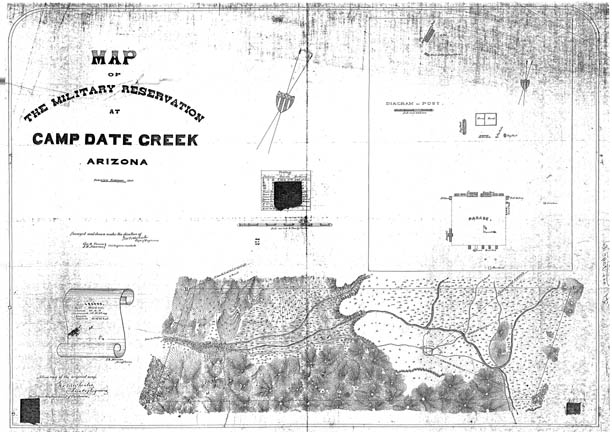
Alfred Johnson was born in 1841 in Truro and, as a young man, followed one of his uncles, Charles Johnson,  to the American West.  He ended up in Arizona, possibly searching for gold, settling near the US Army Post of Camp Date Creek, near present day Prescott.   During the years of 1868 and 1874 it was a US Army outpost established to "deal" with the local Hualapai and Mohave Apache, led by the infamous Geronimo, who were waging a guerrilla style war against the encroaching white population.  It must be said, though, that during this period great atrocities were committed by both sides of this war with thousands of Indians slaughtered in a war of extermination led by General Crook.


Alfred was a victim of one of these raids.  On June 6th 1870, Alfred and a man named "Kentuck" Watson were travelling on the road between Camp Date Creek and Camp Skull Valley when they were set upon by a raiding party and both were murdered.
Camp Date Creek, Arizona

Cemetery records for the Camp Date Creek outpost list only the names of military personnel.  These soldiers were subsequently disinterred and their remains reburied at the Presidio in San Francisco.  There were, however 14 male Caucasians buried in the same cemetery with only wooden crosses to mark their graves. They are all listed in the record as "John Doe".  It is conceivable that Alfred was one of these men.


HMS Challenger
James Campbell Creelman was the husband of my 4th cousin, Margaret Gammell who was a descendant of the Johnsons as well.  As a young man, he left Nova Scotia to settle in Australia and then Fiji.  He was hired by Commodore Lambert to act as pilot for the war ship "HMS Challenger"

In July 1868, the Challenger was sent to Fiji to assist British and Australian settlers who were being set upon by the natives. During one skirmish, 80 Australians went ashore, including our James.  At some point, he received two gun shot wounds from which he died four days later in August 3, 1868.  News of his death was sent home by the British Consul in Sydney, Australia.

Friday, February 17, 2012

The Saga of Captain James Scott Simmonds and Mercy Ann Freeman

Flora Ann Campbell Beattie
This is a great one!
Captain James Scott Simmonds was the uncle of our Great Grandmother, Sarah Simmonds.
- Sarah married William John Campbell and their first child was Flora Ann.
 - Sarah died when Flora Ann was born in 1851.
  - William John Campbell was drowned in the Bay of Fundy in 1860 when Flora was 9 years old.
   - Flora was adopted by William and Isabella (William John's sister) Beattie.
    - Flora Ann Beattie married John William Gamble and their daughter Julia was my Grandma Bragg.

So back to James and Mercy....

James was born near Truro, Nova Scotia in 1794 and by the age of 19, had became a Master Mariner.  He sailed to and from his home port - and on a visit to Eastport, Maine became aquainted with a merchant shipper named Joshua Edwards Freeman.  Joshua introduced James to his sister Mercy who was from New York and had come to keep house for her brother.  Tradition says it was love at first sight and the two were married just a few months later in Truro.

Shortly before their first anniversary, James and Mercy (who was expecting their first child) were attending a neighbour's barn raising when one of the timbers slipped, killing Captain James instantly.  In great shock, Mercy was taken in by her in-laws to await the birth of their baby.  William Henry Simmonds was born in November 1817 and Mercy was very slow to recover.

Through some sort of subterfuge, John Simmonds and his wife Susannah convinced Mercy that their grandson  had died at birth and so Mercy packed up her things and returned to Maine.  She became a seamstress and eventually remarried and moved to Illinois.

Meanwhile, John and Susannah raised the young William, telling him that his mother had died in childbirth when he was born. Like his father, he became a ship's captain at a young age, married and had a family.  They settled in Augusta Maine where William supervised a ship building yard.  One day a young man named Freeman came to him applying for a job.

In conversation, William mentioned that his mother's maiden name was Freeman and that she had married a sea captain who died in an accident and that she had died when he was born.  The young man countered that he had an aunt Mercy Freeman who had married a sea captain in Nova Scotia and who was also killed in a freak accident.  They had a young son, who had died at birth.  The thought haunted William and the next day he convinced the young man to take him to meet this woman.

Evidently, William had grown up looking very much like his father and when he walked into "Aunt Mercy's" home, she fainted dead away.

Overjoyed at this reunion with his mother, William left his ship building business, packed up his family and bought a farm near her home.

Saturday, December 31, 2011

Albert L. Cutten - Killed in the Halifax Explosion


Albert Little Cutten was born in 1880 in Parrsboro, Nova Scotia.  His parents were John R. Cutten and Martha Teed (the granddaughter of both our loyalist ancestors, Daniel Teed and Alexander Peers). He was my 2nd cousin, twice removed and was youngest boy of 10 children. In his early years learned the machinist's trade on the railway.  
  
Hillis & Sons Stove Factory
Shortly after the Explosion


Albert Cutten had left his home at 1376 Barrington Street in Halifax early on the morning of December 6, 1917. The 36 year old machinist made his way to the cast iron stove factory of Hillis & Sons and began his day's work.  About the same time the Norwegian supply ship, the Imo set off into Halifax harbour bound for New York to pick up relief supplies headed for Belgium.  The port was busy with wartime shipping,   Convoys of ships loaded with war supplies of food, munitions and troops gathered in Bedford Basin ready for the voyage to Europe with heavily-armed warships as escorts. Neutral vessels anchored in the harbour, their crews forbidden to land for fear any might supply information to the enemy.


Just outside the mouth of the harbour, the French ship Mont Blanc, prepared to join a convoy.  She was loaded with 2,300 tons of wet and dry picric acid, 200 tons of TNT, 10 tons of gun cotton and 35 tons of benzol: a highly explosive mixture.


Official Death Record
for Albert L. Cutten


After a series of ill-conceived maneuvers, at 9:05 am the Imo struck the Mont Blanc resulting in a massive explosion that destroyed the Halifax Harbour front and much of the town.   Over 12,000 homes were levelled and a complete pane of glass would have been hard to find in the ruble. 
Coffins awaiting removal from
Halifax Mortuary


At the Hillis & Sons stove factory 47 of the 53 workers were killed immediately, including our cousin Albert Cutten.  In total nearly 2,000 people died as a result of the explosion and a further 6,000 were injured - many blinded by flying glass.

Albert was buried in the Cemetery at Parrsboro.


Entry in the Book of Remembrance
Halifax Explosion - Albert L. Cutten

Thursday, December 29, 2011

Dr Edith Caroline Hudgell

Harley Street, London England - 1927

In researching the Bragg Family history, I've unearthed (so to speak) many interesting characters and among them I found Aunt Edith.  A pioneer in medicine and an influential Harley Street physician, she was noted for her probing and insightful papers on the pathology of the criminal mind.  Here's her story:

Dr. Edith Caroline Hudgell became a notable Doctor of Psychiatry and was at one time working at the Elizabeth Garrett Anderson (first English women to practice as a doctor) Hospital for Women in London.

She was born in River Philip, Nova Scotia Canada in 1891.  Her mother was Mary Jane Carter, daughter of Amy Ann Bragg and Theodore Harding Carter.  Her maternal grandparents were John and Jane Bragg, the originators of the Bragg Family of Nova Scotia.  Edith's father was a minister and the family travelled extensively with his missionary work.

On 29 August 1903 at the age of 11  Edith Hudgell travelled with her father Robert William Hudgell on the ship Philadelphia to Boston departing from Southampton England. The journey took 7 days.

At the age of 18 years and 8 months she applied to be a student of the London (Royal Free Hospital) School of Medicine for Women (University of London) in Brunswick Square London in the winter session 1910-11, at the time she was living at Leamington Park Acton London, with her parents. Her education was given as American schools: Kelland College, Leicester, Wandsworth Technical Institute, secondary School, Paddington County secondary school.

   Her qualifications gained were London Matriculation (School Leaving) and Oxford Senior Local (Third Class Honours) July 1909 and she was applying to the Royal Free to study for her London M.B.,B.S.

Appointments:

• 1917 House Physician, Royal Devon and Exeter Hospital, Exeter
• 1918 Medical Officer, No.5 Section, V.A.D. Hospital, Exeter
• 1919 Medical Officer, Home Office, Holloway Prison

Holloway Prison


Holloway Prison

 • 1920                 Acting Medical Officer, HM Prison, Holloway
 • 1921                 Medical Officer, HM Prison, Holloway
 • 1923-1933          Assistant Medical Officer Venereal Disease Dept, Royal Northern Hospital                                                                                                                                                                                                                               
 • 1936-1941          Harley Street London and Royal Northern Hospital
 • 1945-1959          Psychiatric Dept., St Georges Hospital, London SW1
 • 1959-1965          Duncanson House, Bromley Kent
 •  1965                        Retired from practice Harley Street London

John Bragg, of Collingwood  fondly remembers the regular visits Edith made to Nova Scotia to connect with her Canadian Family.  She passed away in 1974 in Swindon, Wiltshire, England - another fascinating leaf on the Bragg Family Tree.


Sunday, December 18, 2011

Christmas at Windham Hill

The year is 1880 and my name is Lucy Jane Bragg Taylor. I live with my husband Andrew in Williamsdale, Cumberland County, Nova Scotia.  I'm 35 years old, having just had a birthday on December 19th.  Andrew and I have been married for 7 years and this year, we are going to spend Christmas at my old family home at Windham Hill - about 14 kilometres from here.  We're taking the children, Rose, Elizabeth Ann and John Woodland who will enjoy playing with all their Bragg cousins.


My father, John Bragg is a farmer but he also acts as Justice of the Peace in River Philip.  He was appointed by Sir Charles Tupper, one of the Fathers of Confederation and a distant relative.  He presides over the monthly "sessions" that settle civil disputes and petty crimes.  Father came from Somerset, England and still has an English accent.  He was an apprentice blacksmith in his homeland and was taught to read and write by his Master in the dust on the shop's anvil.  When he was about 20, he found a job aboard a ship bound for Canada.  On arriving at Pugwash, he left the ship and followed the River Philip, through the woods and up to Windham Hill.  He cleared the land to make a large farm and his buildings were among the best in the area.  Father was a strong supporter of education, so when we were children, he hired a teacher who lived with us and gave us our lessons.   A few years after arriving here, my father met my mother who was visiting her sister - a neighbour of his.


My mother was born Jane Rogers in Lutes Mountain, near Moncton.  Her sister, Sarah had married Thomas Dobson Taylor who lived at Windham Hill.  Sarah is my Andrew's mother which makes us first cousins.  Mother and Father married in 1838 and went on to have 7 children, Lizzie, Amy Ann, Charlie, Robert, Willie and me.  


Lizzie died about 10 years ago from consumption, and her little boy followed her soon after.  


Amy married Harding Carter and they had six children but has lost three of them, John Bragg, aged 3; Ada Belle, aged 17 and Arthur, aged 23. 


 Charlie married Matilda Swallow Vincent, a widow with a daughter Eldora.  Matilda came from an old Loyalist family in Wentworth and they have 6 children.  Matilda is expecting next month and they are hoping for a boy who will be named John Thomas, after Father.  Charlie runs a general store in Collingwood Corner and also sells lumber.


Robert is not married but is seeing Angelina Ryan, so I'm sure there will be another family wedding soon.  


Willie is married to Mary Crossman and they live in Shepody, New Brunswick. 


 John is married to Cecelia King and they are planning to move to Duchess County in New York to open a bakery.  


So there will be a lot of us up on Windham Hill for Christmas.  Father and the boys will go out into the woodlot to pick the very best tree while Mother and us girls will pop popcorn to string.  There will be berries and crab apples and nuts to string, too.  We have dozens of little white candles to mount on the branches and we are making little snow balls from lamb's wool.


Tomorrow morning we will all pile into our sleighs for the trip to church.  The little church at Oxford Junction.  The church was built by my brother-in-law, Harding Carter in time for his wedding to Amy Ann 13 years ago. The lumber came from Father's woodlot.   


I can picture it now - lit by hundreds of candles and smelling of pine boughs.  There will be singing of carols and a spot of warm apple cider spiced with cinnamon before we start our trek home.


The children will play with their new toys from Father Christmas while we prepare the goose and trimmings for the family dinner later in the afternoon.  The table will be laid with Mother's best linens and overflowing with delicious delicacies.  Father will tell stories of his young life in Chaffacombe, Somerset and the boys spar over clever wordplay - a long running Bragg family trait.  The ladies will catch up on all the family news and we will all go to bed fat, happy and full of gratitude for the wonderful Christmas at Windham Hill.


(Author's note:  All the people and events in this story are real but I've used my imagination to fill out some of the details.  To all my family Bragg or otherwise - I hope your Christmas will be just as nice as the one I've imagined for our ancestors)

Thursday, November 10, 2011

Let Us Remember

Cenotaph at Malagash, Nova Scotia

The Keeper
by Marilyn Bragg

The old man stands there wizened and bent
And watchs through tears as they play the lament.
I am the keeper, he says in his mind.
I am the one he left behind.

I am the keeper of memories
When others seem to forget.
I am the one who remembers
As though he were living yet.

I see his face and remember his jokes.
I see the tears as he spoke of the folks.
I see the fear in a best pal's eye.
I hear him hide in the dark and cry.

I see him die in the blood and the gore.
I see him fall to fight no more.
I stand at his grave in the cold smoky air.
And promise I'd always be there.

We were merely boys back then
And ready for a laugh.
Now I'm keeper who stands alone
And weeps at the Cenotaph.

Lest we forget.


This poem is dedicated to the Keepers in my family, Pvt. Vernon Treen, P/O John Edwin Bragg, Red Cross Nurse Florence Laughlin Bragg, Pvt. Leonard Treen, Pvt. Leo Dowd, Sgt. Joe Harrigan and S/L Rusty Bragg.


And to family members who paid the ultimate price in war:  Sgt. Beldon Treen - killed at Vimy Ridge; Lance Corporal Burton Treen - gassed at Hill 70; Pvt. Stanley Treen - killed at Amiens; and P/O Douglas W. Peers - killed in action over Germany 1944. F/O Donald Nelson, killed in Korea,  Second Lieutenant Samuel Tilley Harrison - killed in action September 29, 1918 in France.

Friday, October 21, 2011

Rogers, Johnson and Bragg - More Branches Entwined

Researching the Bragg Family Tree is a bit like playing a game of Clue.  You get a piece of information and then another and suddenly the whole picture falls into place.

"How", I asked myself, "Could a young woman in the 1780s from Truro, Nova Scotia meet and marry a man from Shepody, New Brunswick?"  Bit by bit, details came together and yesterday the whole story was revealed.  Here it is:

The Hopewell
In 1760, Alexander McNutt, a land agent, travelled to Londonderry, Northern Ireland to recruit potential settlers for the area along the Bay of Fundy from which the Acadiens had been expelled six years earlier.  That year, he also visited Londonderry, New Hampshire for the same purpose.  In Ireland, he met John Rogers and convinced him that the Cobiquid would offer him free land and a fresh start.  Similarly, in New Hampshire, he met brothers, James and John Johnson.  In 1761, the Rogers arrived aboard the ship Hopewell and settled at Londonderry and the Johnsons settled at Truro.  Being part of the McNutt group, the families knew each other and did business back and forth in the early years in Nova Scotia.

Grave of James Rogers
John Rogers was born in 1733 in Northern Ireland and at the age of 20, married Elizabeth Spencer who was only 12 at the time.  They had six children, the eldest being James Rogers.  After many years in Nova Scotia,  James and three of his brothers applied for and got a land grant in Shepody in the area that later became New Brunswick.

James Johnson was born in 1719 in Londonderry, Northern Ireland and married Elizabeth Patterson in 1744 in New Hampshire.  They had eleven children, the youngest being Rachel who was born in 1768 in Castleton, Vermont.


Home of John Bragg and Jane Rogers
at Windham Hill
James Rogers visited his family in the Cobiquid in 1788 and met Rachel Johnson.  The two were married the same year in Shepody and went on to have six children.  Jane, their youngest was born in 1809 and during a visit with her sister, Sarah Rogers Taylor at Windham Hill, Nova Scotia,  met and fell in love with John Bragg, a neighbour. And thus, the Braggs, the Johnsons and the Rogers branches of the family joined, connecting us to this history of courage, adventure and longevity.


Grave of William Woodland Bragg
and Mary Crossman
In 1875, William Woodland Bragg, son of John Bragg and Jane Rogers, met and married Mary Crossman, the daughter of Howard Crossman and Rosannah Rogers, the granddaughter of James Rogers and Rachel Johnson and the niece of Jane Rogers Bragg.

This year celebrates the 250th arrival in Nova Scotia of the Rogers, Johnsons and their neighbours who were called the Cobiquid Planters.  Our roots, however entwined, are deep and lasting.


Sunday, October 16, 2011

The Bragg Family Tree - Branches Entwined

Last resting place of William, Catherine and their children
 I guess it stands to reason that over the years various branches of our Bragg family would come together. Nova Scotia, after all is a small place and the population in the mid 19th Century was still under 200,000 souls. One such example is William McKim Peers and Catherine Johnson.


Pedigree of William McKim Peers
William was the grandson of Alexander Peers and May Bolding our United Empire Loyalist ancestors who came to the Remsheg (Wallace Bay) in 1783 after the American Revolution.  His parents were the infamous Ephraim Peers the Justice of the Peace and Patience Horton, daughter of another prominent UEL family.  William was born in 1831 and in his12th year lost his father when Ephraim dropped dead suddenly on the steps of the courthouse.  Along with his eight brothers and sisters, the family kept their farm running and in later years, young William would take it over.  William is directly connected to us through Matilda Swallow, mother of our grandfather, John Thomas Bragg.  He was my 1st cousin, 4 times removed.

Pedigree of Catherine Johnson
In 1859 he met and married Catherine A. Johnson in Truro.  Catherine's parents were 2nd cousins, Robert and Rachel Johnson which made her a double descendant of James and John Johnson, founders of the town of Truro and known as the Cobiquid Planters.  The Planters came to Nova Scotia in 1761 from New Hampshire and 2011 was the 250th anniversary of their arrival.  Catherine was born on July 1, 1839 in Truro but after their marriage, she and William lived on the Peers farm at Wallace Bay.  Catherine is directly connected to us through Jane Rogers, wife of John Bragg, Esq. our great great grandfather.  She was my 2nd cousin, 3 times removed.

Over the years, William and Catherine had fifteen children; Isabel, Margaret, Ephraim, an infant daughter, Mary Netta, an infant daughter, Catherine, an infant daughter, Lillian, Nina, Harriet, Annie, Charles Creed, Campbell Wentworth and Gordon.  Three of their little girls were stillborn and of the others, Mary Netta died at 23, Lillian died at age 9, Nina died at age 7, and Charles died at age 2.

Wallace Bay Cemetery
William died in 1897 at Wallace Bay at the age of 66 and was buried at the Wallace Bay Cemetery.  Catherine lived until 1907 and died at the age of 68.  She was buried at Wallace Bay with William and their young children.

And so, this is how these two families, each with their rich and interesting histories - the Peers with their Revolutionary War adventures and the Johnsons with their pioneering spirit - came together.


Tuesday, October 4, 2011

Daniel Starritt Gamble - Johnny Appleseed was a Gamble?


Daniel Starritt Gamble was my 1st cousin, 3 times removed.  He was the son of my grandmother, Julia Gamble's uncle Robert.


Exerpt from an article in the Brewster Washington News - 1908 

Daniel Starritt Gamble and grandson, Dan
Gebbers
Daniel Starritt Gamble was born in Castlereagh, Colchester County, Nova Scotia, on February 16, 1867, the son of Robert and Deborah (Reid) Gamble, natives of the same place, and where they still live, aged seventy-four and sixty-eight respectively. They were the parents of seven children: Mrs. Malinda Muhe, deceased; Daniel S., our subject; John, deceased; Martha, deceased: Joseph; Charles; Chesley R. All of those living are in Nova Scotia, except our subject. From the common schools of his home place Mr. Gamble received his education and learned the trade of carpenter and builder during his youth. In 1885 he came to Lansing, Michigan, whence one year later he went to Oakland, California, and labored in the bridge construction department of the Southern Pacific for five years. In the spring of 1890 he accepted a position with the San Francisco Bridge Company, and later came to this state. Here he did contracting and building. He put in the Ferry at Virginia City and Chelan Falls and operated the Virginia City ferry, just below Bridgeport. He also bought and sold horses. In 1898, as stated above, Mr. Gamble entered the hotel business and has made good success of it since that time.

On February 18, 1896, Mr. Gamble married Miss Cora May, daughter of Stephen C. and Ursula Munson, natives of Maine and pioneers to California in the early fifties. In 1885 the family came to Okanogan county, where Mr. and Mrs. Munson both died. Mrs. Gamble was born in California on October 7, 1877, and has two sisters, Mrs. Joseph Hilton and Mrs. Annie L. Walton. Two children have been born to Mr. and Mrs. Gamble, Martha U., aged four and Cyril H., aged two. Mr. Gamble was one of the first to settle where Brewster now is and has ever been active in building up the town and for the general welfare of the county.

In 1885 Dan Gamble arrived with his backpack to the Harts Pass area in Washington State having walked from Nova Scotia for the beginning of the upper Methow gold rush. Later, he chased the silver boom at Ruby in the Okanogan valley. He first established a saw mill in the mouth of Cactus Canyon near Brewster in 1894 where he caught and milled drift wood out of the river. He followed up this venture with the establishment of the Gamble Hotel and steamboat landing on the banks of the Columbia River.

Dan Gamble's Hotel in Brewster, Washington
Daniel Starritt Gamble, who is proprieter of the Hotel Gamble at Brewster, is one of the leading business men of the Okanogan county and is well known in this portion of Washington. He is proprietor of one of the finest hotels in this part of the state and has labored steadily and with telling results in building up Brewster and the surrounding country. In 1898 Mr. Gamble was engaged in the hotel business at Brewster, beginning business in a small house, which was enlarged from time to time until he now has an elegant three story structure eighty feet deep, with a frontage of seventy-six feet. It has forty sleeping apartments, in addition to a spacious dining room, sample room, office, kitchen and so forth. The rooms are large and light and the building is handled in a first-class manner. Mr. Gamble has supplied his hotel with a private water system that gives an abundance of water to all parts of the house. As a host he is affable and genial and a favorite with the traveling public.

Dan Gebbers, grandson of Daniel Gamble
was the model for the family run
apple business advertising
He planted his first apple orchard in Brewster in 1910. He incorporated Gamble Lumber Company and a second saw mill located on Paradise Hill in 1910, with a large part of the production being wooden apple boxes. He built his first apple packing shed in Brewster in 1918.

Daniel died in Brewster in 1939 at the age of 72.